Katie Martin performs Lori Laitman’s “If I…”

SV_Taso_Katie_portrait_2_color_webLori Laitman is recognized today as one of the America’s most successful and creative living composers. She has composed three operas, an oratorio, and other choral works. In more than 250 songs, she is revitalizing the fusion of poetry and music in song, and helping to continue the tradition of of American art song in the twenty-first century.

For our recent AMERICAN PILGRIMAGE concert, soprano Katie Elizabeth Martin offered Laitman’s tender Dickinson setting “If I…”

EMILY DICKINSON (American, 1830-86)

If I can stop one heart from breaking,
I shall not live in vain;
If I can ease one life the aching,
Or cool one pain,
Or help one fainting robin
Unto his nest again,
I shall not live in vain.

View Katie’s performance by clicking here.  Mark Salters is at the piano.

(Photo courtesy of Taso Papadakis)
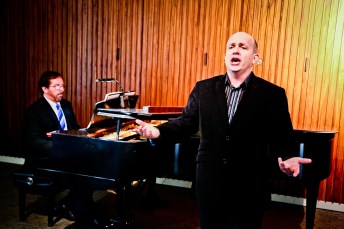
Charles Ives “Religion” and “The Cage,” performed by Gerald Seminatore

SV_Taso_Gerald_animated_singing_color_webFor our recent AMERICAN PILGRIMAGE concert, tenor Gerald Seminatore and pianist Mark Salters offered songs by Charles Ives ( 1874-1954). (Links to performance videos of two songs appear below.)

Ives was one of the most original of twentieth century American composers. In more than 100 songs, Ives wove together original melodies, fragments of popular songs and hymns, and harmonies of sweet simplicity or crashing dissonance. There is a pronounced nostalgia in many Ives songs, and sometimes a humorous or ironic note. Two of these songs–“Religion” and “The Cage”–are models of economy, brevity, and harmonic expressiveness.

"Religion" (1920), words Dr. James Thompson Bixby

 There is no unbelief.
 And day by day and night by night, unconsciously,
 The heart lives by faith the lips deny;
 God knows the why.

Click here for Gerald's performance of "Religion." 

"The Cage"(1906), words by Charles Ives

 A leopard went around his cage
 From one side back to the other side;
 He stopped only when the keeper came around with meat;
 A boy who had been there three hours
 Began to wonder, “Is life anything like that?”

Click here for Gerald's performance of "The Cage." 


(Photo courtesy of Taso Papadakis)

Arnold Geis performs Richard Hundley’s “Isaac Greentree”

SV_Taso_Arnold_portrait_webOn our recent AMERICAN PILGRIMAGE concert, tenor Arnold Geis offered songs by composer Richard Hundley. For “Isaac Greentree” (1981), Hundley adapted a text from Samuel Palmer’s “Epitaphs and Epigrams: Curious, Quaint, Amusing” (1869). Arnold’s performance captured both the lyricism and the tenderness of this epitaph. (The text appears below.)

Click here to view Arnold’s performance of “Isaac Greentree” on YouTube.
Mark Salters is at the piano.

(Photo courtesy of Taso Papadakis)


In springtime comes
The gentle rain,
Soothing honey sweet breeze
And sheltering sun.

Beneath these trees
Rising to the skies

The planter of them
Isaac Greentree lies.

The time shall come
When these trees shall fall
And Isaac Greentree rise
Above them all.

Katie Elizabeth Martin performs Copland’s “Why do they shut me out of Heaven?”

SV_Taso_Katie_portrait_2_color_webEmily Dickinson (1830-86) is universally recognized as one of the most important literary voices of the American experience. Her poems have attracted many composers, and Aaron Copland’s “Twelve Poems of Emily Dickinson” are some of the finest musical settings of Dickinson in the American song repertory.

We are pleased to share a video of Katie Elizabeth Martin singing Copland’s “Why do they shut me out of Heaven?” This live performance is from our recent AMERICAN PILGRIMAGE concert at the Brand Library in Glendale, CA. (Photo courtesy of Taso Papadakis.)

Click here to view Katie’s live performance of “Why do they shut me out of Heaven?


EMILY DICKINSON
(American, 1830-86)

Why—do they shut Me out of Heaven?
Did I sing—too loud?
But—I can say a little “Minor”
Timid as a Bird!

Wouldn’t the Angels try me—
Just—once—more—
Just—see—if I troubled them—
But don’t—shut the door!

Oh, if I—were the Gentleman
In the “White Robe”—
And they—were the little Hand—that knocked—
Could—I—forbid?